Category: Supply Chain and Logistics Management
4 Important Skills To Have If You’re Considering Global Supply Chain And Logistics Training
April 29, 2024




A global supply chain manager is responsible for the worldwide product flow management of an organization. During global supply chain and logistics training, you will learn a wide variety of skills to prepare you for the role.
During your logistics management diploma, the skills you will learn include data analytics, contracting, operations management, quality management, customs and global trade compliance, warehousing, communications, and supply management.
You also have the opportunity to sit the Canadian International Freight Forwarders Association certification exam and the Lean Six Sigma Yellow Belt certification exam. Your training will thoroughly prepare you to succeed in a global supply chain and logistics role, however, to do this, you also need good foundational skills.
Discover the essential skills needed for global supply chain and logistics training. Check out this infographic!
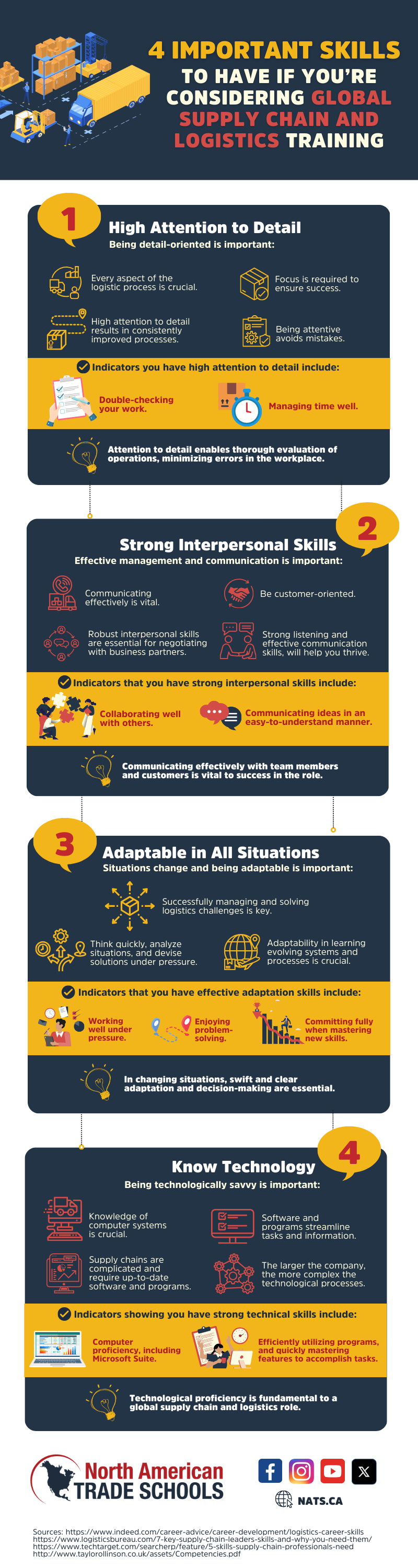
[Infographic] 4 Important Skills To Have If You’re Considering Global Supply Chain And Logistics Training
1. High Attention to Detail
Being detail-oriented is important:
- Every aspect of the logistic process is crucial and plays an important role.
- You’ll need to focus on the details to ensure success throughout the supply chain.
- High attention to detail often results in consistently improved systems and processes.
- Being attentive helps avoid mistakes.
Indicators you have high attention to detail include:
- Double-checking your work.
- Being a person who manages their time well.
Strong attention to detail enables thorough evaluation of operations, minimizing errors in the workplace
2. Strong Interpersonal Skills
Managing and communicating effectively is important:
- In a management role, your ability to communicate effectively is important.
- Effective communication and robust interpersonal skills are essential for interacting and negotiating with business partners.
- Be customer-oriented to ensure client satisfaction and continued business.
- Strong listening and effective communication skills, will help you thrive in a global supply chain management role.
Indicators that you have strong interpersonal skills include:
- You can collaborate with others whenever needed.
- You can communicate your ideas in an easy-to-understand manner.
You need to be able to communicate effectively with team members and customers to succeed in the role.
3. Adaptable in all Situations
Situations change and being adaptable is important:
- Successfully managing and solving logistics challenges is key to excelling in your role.
- You must think quickly, analyze situations, and devise solutions under pressure.
- Adaptability in learning new systems and processes is crucial as they evolve.
Indicators that you have effective adaptation skills include:
- You work well under pressure.
- You enjoy problem solving.
- You commit fully when mastering new skills.
In changing situations, swift and clear adaptation and decision-making are essential.
4. Know Technology
Being technologically savvy is important:
- Supply chains are complicated and require software and programs to remain up-to-date.
- The software and programs streamline tasks and information.
- Knowledge of computer systems is crucial.
- In larger companies, technological processes become more complex due to the increased volume of information to manage and update.
Indicators showing you have strong technical skills include:
- You know how to navigate a computer system well, including Microsoft Suite.
- You can efficiently utilize programs, quickly mastering their features to accomplish tasks.
Understanding and working with technology is fundamental to a global supply chain and logistics role.
Sources:
https://www.indeed.com/career-advice/career-development/logistics-career-skills
https://www.logisticsbureau.com/7-key-supply-chain-leaders-skills-and-why-you-need-them/
https://www.techtarget.com/searcherp/feature/5-skills-supply-chain-professionals-need
Navigating the Post-pandemic Landscape after Logistics Training
April 15, 2024

The logistics industry has undergone a seismic shift after the global pandemic. The pandemic has significantly affected supply chains, transportation, and logistics worldwide. Trade restrictions, port closures, and workforce reductions have led to disruptions, obliging logistics professionals to adapt swiftly. With a surge in e-commerce, evolving customer expectations, and ongoing supply chain disruptions, the landscape for logistics training graduates has become more dynamic than ever.
Fresh out of logistics training, you’re equipped with the knowledge and skills to navigate this new reality. However, translating textbook concepts into practical solutions in a post-pandemic world requires a strategic approach. This blog post highlights some key areas to focus on as you embark on your logistics career:
Embrace Flexibility and Adaptability and Deepen Your Understanding of E-Commerce
The pandemic highlighted the importance of agility in the face of unforeseen circumstances. Gone are the days of rigid, linear supply chains. Today’s logistics professionals must be adaptable and capable of quickly pivoting strategies and workflows to address disruptions.
This means staying abreast of industry trends, emerging technologies, and geopolitical issues that could impact global trade. Familiarize yourself with alternative solutions, such as diversified sourcing strategies and multimodal transportation options.
As most logistics courses highlight, E-commerce has become a dominant force in the retail landscape. As a logistics professional, understanding the intricacies of e-commerce fulfillment is crucial.
This includes knowledge of warehousing and inventory management specific to e-commerce needs, such as streamlined picking and packing processes, efficient last-mile delivery solutions, and robust reverse logistics systems for returns and exchanges.
Familiarize yourself with e-commerce platforms and marketplaces and the fulfillment models they utilize. Understanding customer expectations for fast, reliable deliveries is paramount.
Leverage Technology and Prioritize Data Security
Technology is transforming the logistics industry at an unprecedented pace. Various tools can enhance efficiency, productivity, and data-driven decision-making, from warehouse automation to blockchain-powered supply chain tracking.

Embrace opportunities to learn about and utilize logistics management software, warehouse management systems, and transportation management systems. Familiarity with data analytics tools will position you well as companies increasingly rely on data to optimize operations and predict demand.
Cybersecurity threats are growing in the logistics industry, where valuable data is constantly moving. As a logistics professional, you play a vital role in protecting sensitive information such as customer data, trade secrets, and shipment details.
Develop and implement best practices for data security, including vital password hygiene, awareness of phishing scams, and adherence to data privacy regulations.
Develop Strong Communication Skills and Build Your Network after Logistics Training
Effective communication is vital across industries, but it is especially crucial in logistics, where efficient collaboration between departments and external partners is key.
Work on refining your written and verbal communication skills during and after your logistics training. Practice active listening and clear articulation during meetings and negotiations. Effective communication fosters trust and transparency, leading to better problem-solving and smoother workflows.

Building strong professional relationships is vital to career growth in the logistics industry. Attend industry events, connect with logistics professionals online, and don’t hesitate to engage with industry experts.
Mentorship from experienced professionals can provide valuable insights and guidance as you navigate your career path. Additionally, a strong network opens doors to new opportunities, allowing you to stay current on industry trends and informed about job openings.
Are you looking for world-class career training?
Contact NATS for more information.
Tips For Operations Planning After Supply Chain And Logistics Training
April 10, 2024

The ultimate goal of operations planning is to properly and consistently align and optimize the flow of supply chain resources to satisfy customer demands efficiently at all times. Because proper operations planning is key to the success of every logistics business, it is essential to have the right approach.
If you’ve just finished your Supply Chain and Logistics training and fancy a career in operations planning, you’ll find the information here very valuable. Here are some important tips for operations planning to keep in mind on your journey.
Map Out Your Supply Chain Process Flows
The process flows around your supply chain and provides a trail of activities that allow you to track your operations planning. To understand these process flows and their implications on your supply chain operations, map them out extensively and observe every detail. Document the sequence of events from the time of order and procurement through the storage, distribution, and delivery processes leading to the final consumer.
Also, highlight all the inputs, outputs, logistics, operations, and key players actively participating in each stage and analyze their interaction. When you do this properly and effectively, you will have figured out any gaps, inefficiencies, and problem points in your supply chain.

Logistics Management Training Teaches Comprehensive Supply Chain Infrastructure Analysis
When you conduct a thorough supply chain infrastructure analysis, you can find out what works well, optimize those processes, and identify areas needing improvements or upgrades. This analysis should cover the condition of your warehouses, transport fleet, staffing capacity, equipment, and other technology systems that your supply chain operations rely on.
This allows for easy discovery of any bottlenecks, outdated processes, and capacity constraints that impact your operation. After identifying your operational challenges, you can now make plans and deploy the right personnel to make all the necessary improvements. This analysis process is emphasized in most logistics management training programs as it helps pave the way for more informed decision-making by logistics managers.
Examine Supply Chain Key Performance Indicators (KPIs)
Your KPIs are key to evaluating your supply chain’s performance level in line with set parameters and standards. When you assess your supply chain’s KPIs and compare them to industry standards, you can find out what competitive gaps need closing and what standards need reinforcing. Your KPIs typically include total supply chain costs, inventory turnover rates, and lead times.
They influence many activities accounted for in your operations planning and define your supply chain. And because they constantly change as operations play out, you’ll need to put them within range of a regular monitoring system. This way, you’ll always know what direction to take while planning your operations.

Identify Risks and Create Actionable Mitigation Plans
Risk analysis in operations planning is a feature of many logistics management courses due to its importance. While carrying out operations planning, it is important to do proper risk analysis around your supply chain. Your risk analysis should cover all activities in your operations, from supply to distribution and delivery.
After examining the various risk factors associated with your supply chain operations, you can make appropriate mitigation plans. If you find that there’s potential for a particular process to no longer be applicable, reliable, or practical, you can create a contingency plan to cover it.
Are you interested in a logistics management diploma?
Contact NATS today to learn how you can get started.
The Function of Data Analytics in Your Future Supply Chain and Logistics Career
January 16, 2024

The role of data analytics in supply chain and logistics is becoming increasingly important in the future. In an increasingly data-driven world, the ability to analyze, interpret, and apply data effectively will become more crucial than ever. This blog post explores how data analytics will function in supply chain and logistics careers, outlining its significance and the potential transformations it might bring.
Data Analytics Allows for Enhanced Decision-Making
The most immediate impact of data analytics in supply chain and logistics is decision-making. With the integration of comprehensive data analysis tools, professionals can make more informed decisions. Supply chain managers can identify patterns and trends in historical data with historical data analysis, resulting in insights that assist in strategic planning and execution.
Data analytics provides insights into customer behaviour, market trends, and supply chain efficiency, allowing for more strategic planning and execution. This means anticipating market changes, adapting to consumer demands more quickly, and optimizing operations for better performance throughout your supply chain and logistics career.
Improved Efficiency and Increased Cost Reduction
One of the primary goals of any supply chain is to maximize efficiency while minimizing costs. Data analytics plays a crucial role here. By analyzing patterns and trends in the supply chain, professionals can identify inefficiencies and bottlenecks. This can improve various aspects, such as inventory management, transportation routes, and supplier selection. Predictive analytics can be particularly beneficial, helping to anticipate and mitigate potential disruptions before they occur.

Data analysis improves demand forecasting, a critical aspect of supply chain management. Advanced analytics can identify patterns in vast datasets, allowing for accurate predictions of future product demand. This capability ensures companies can meet customer expectations and optimize inventory management, preventing overstocks and stockouts.
Enhanced Customer Experience Through Personalization
Today’s competitive market places a high priority on customer satisfaction. Data analytics enables a more personalized customer experience by understanding and predicting customer needs and preferences. For instance, companies can tailor their services and products more effectively by analyzing purchase history and customer feedback. In addition to improving customer satisfaction, this can lead to repeat business and loyalty.
Supply Chain and Logistics Training Emphasizes Sustainability and Ethical Practices
Sustainability is increasingly becoming a priority for businesses. Data analytics can help supply chain and logistics professionals make environmentally friendly decisions. By analyzing data related to carbon footprints, waste management, and resource utilization, companies can identify areas for improvement and ensure they meet regulatory requirements. This also aids in boosting a brand image that appeals to environmentally conscious consumers.
Efficient Risk Management With the Integration of Emerging Technologies
Supply chains are susceptible to various risks – from natural disasters to geopolitical issues. Data analytics enhances risk management by providing tools to identify, assess, and mitigate risks. Predictive analytics can forecast potential disruptions, allowing companies to develop contingency plans. This proactive approach to risk management ensures greater resilience and stability in the supply chain, per supply chain and logistics training.

Finally, data analytics is crucial in integrating emerging technologies like AI, IoT, and blockchain into supply chains. These technologies generate vast amounts of data, which, when analyzed effectively, can lead to groundbreaking innovations in supply chain management and logistics.
Are you interested in supply chain logistics courses?
Contact NATS for more information.
The Value Of Strong Communication Skills For Those In Logistics Management Training
December 15, 2023

If you’re considering a dynamic career in logistics, it’s time to acquire the many industry skills you’ll need to succeed. Our online supply chain and logistics diploma program covers all key competencies that an effective logistics professional requires. Students get a comprehensive introduction to the Canadian supply chain industry and how related operations needs come into play.
You’ll get comprehensive lessons in computer and software applications, purchasing and contracting, order management, operations planning, warehousing, and logistics. Students are introduced to communications best practices – an essential skill that keeps the supply chain’s many moving parts organized and manageable. Keep reading to learn more about the role of a logistics administrator, the value of communication skills, and some essential communication best practices to remember.
The Role of an Administrator in the Logistics Field
Supply chain and logistics managers are multifaceted and responsible for creating supply chain strategies, monitoring logistics, updating a company’s inventory, analyzing operational performance, collaborating with vendors, and resolving any issues.
Success in this role requires a strong understanding of the supply chain process, mishaps that can occur along the way, and troubleshooting techniques for quickly restoring order. They must possess excellent problem-solving abilities, great attention to detail, and strong organizational and communication skills. Let’s explore the value of proper communication after logistics management training.

The Importance of Strong Communication After Logistics Management Training
Communication barriers are the often common deterrents to effective supply chain and logistics management. Strong communication supports logistics professionals’ ability to maintain strong customer relationships, seize advantageous opportunities, maintain a positive company reputation, stay punctual, and drive revenue increases.
The supply chain and logistics field involves collaboration between various team members in different departments and parts of the world. Your ability to communicate effectively will help your team navigate the daily challenges within the logistics field. These include market volatility, compliance with various ethical requirements, and information overload.

Communication Best Practices to Remember
Effective logistics communication can pose a challenge; however, after logistics management courses, many best practices can facilitate effective communication. For example, using software solutions to centralize email inboxes, automating responses where possible, and organizing tasks in an easily digestible format for team members can expedite communications.
When you complete our logistics management diploma program, you will be fully equipped with the skills to optimize a wide range of software solutions and become an invaluable resource to any organization.
Are you ready to take our logistics management program online?
Contact North American Trade Schools to learn more!
In Logistics Management Training? Discover the Use of AI in the Industry
November 21, 2023

The logistics industry is in a revolutionary transformation with the integration of Artificial Intelligence (AI). Artificial intelligence is deployed to automate and enhance supply chain operations. The rising array of AI-driven advancements coupled with the escalating expenses related to manual labour makes adopting AI in logistics increasingly appealing.
As a catalyst for efficiency, accuracy, and innovation, AI is reshaping logistics operations, from supply chain management to last-mile delivery. In this blog post, we explore how AI is being used to revolutionize how we strategize, execute, and refine the flow of goods between different locations.
Enhancing Efficiency Through Predictive Analysis
AI’s impact on the logistics industry is primarily driven by predictive analytics. By analyzing vast datasets, AI algorithms can predict trends and potential disruptions and optimize operations. Predictive analytics empowers logistics professionals to anticipate demand fluctuations, weather-related challenges, and equipment maintenance needs. This proactive approach prevents disorders and enables more efficient resource allocation, reducing costs and improving overall supply chain performance.
Route Optimization and Resource Allocation
As you’ll discover in logistics management training, route planning and resource allocation are logistical intricacies that can significantly impact operational costs. With its ability to process real-time data and consider numerous variables simultaneously, AI optimizes these critical aspects. From considering traffic patterns and fuel costs to evaluating vehicle capacities, AI algorithms create efficient routes, minimizing time and expenses. Logistics companies leveraging AI in route planning gain a competitive edge by enhancing delivery speed, reducing fuel consumption, and improving overall fleet management.

Real-Time Tracking for Enhanced Visibility
The demand for real-time visibility in logistics has never been greater, and AI is meeting this demand head-on. Advanced tracking systems powered by AI provide real-time insights into the location, condition, and estimated arrival times of shipments. This level of visibility is crucial for logistics managers required to make informed decisions on the fly. Whether it’s monitoring a shipment’s progress or identifying potential delays, real-time tracking enhances overall supply chain transparency and responsiveness.

Logistics Management Training Hyperautomation
Hyperautomation, integrating AI, machine learning, and robotic process automation, is a game-changer in logistics. By automating routine and rule-based tasks, hyperautomation frees up human resources to focus on strategic decision-making. As our logistics management courses emphasize, warehouse management, order processing, and inventory control are areas hyperautomation can significantly impact. Logistics companies embracing hyperautomation are experiencing streamlined operations, reduced errors, and improved overall efficiency, contributing to a more agile and responsive supply chain.
AI-Powered Risk Management
The logistics industry confronts many risks, spanning natural disasters to geopolitical uncertainties. In addressing these challenges, Artificial Intelligence (AI) emerges as a pivotal player in risk management. By scrutinizing historical data, AI identifies potential risks before they escalate, fostering a proactive approach to risk mitigation. This capability empowers logistics companies to formulate comprehensive contingency plans, guaranteeing business continuity and resilience in the event of unforeseen challenges and fortifying their ability to navigate the complex and unpredictable operational landscapes encountered daily.
Are you interested in our world-class logistics management diploma?
Contact NATS for more information.
3 Compliance Tips For Students In Logistics Training
October 16, 2023

Logistics, the critical backbone of modern supply chains, requires meticulous attention to detail and adherence to many regulations. As global trade expands and regulations evolve, it becomes crucial for professionals in this field to stay updated and compliant.
For students undergoing logistics training, understanding compliance ensures that their future operations run smoothly and keeps businesses and their clients safe from legal repercussions.
Here are three crucial compliance tips that every student in logistics training should embrace.
1. Stay Abreast of Global and Local Regulations After Logistics Training
In the rapidly evolving landscape of international and national trade laws, students in logistics need to remain informed. Changes in these regulations can stem from political shifts, the advent of new technologies, or alterations in global trade patterns.
Neglecting to stay abreast of these changes can result in severe operational setbacks and substantial fines. As a proactive measure, students in logistics training should consistently monitor the official sites of international trade bodies, local customs offices, and regulatory authorities.

Furthermore, participation in relevant seminars, workshops, and conferences can offer updated knowledge, while subscribing to logistics-focused newsletters and journals ensures a steady flow of current information. Crucially, building connections with seasoned professionals in the domain can grant insights beyond textbook teachings, enriching the comprehension of real-world compliance challenges.
2. Emphasize the Use of Technology in Compliance
With the challenges of today’s logistics terrain, tech tools, ranging from software that simplifies tariff and duty calculations to platforms enabling real-time shipment tracking, are invaluable assets for professionals.

For students preparing to navigate this landscape, it’s imperative to be well-acquainted with the latest technological advancements. This involves understanding these tools and their compliance-enhancing features and deep-diving into hands-on training simulations. Practical experiences can offer irreplaceable insights.
Further, staying at the forefront of evolving tech trends is essential, like integrating blockchain for transparency or leveraging artificial intelligence to foresee and counteract compliance challenges.
3. Ethical Practices and Sustainable Operations
As our logistics courses emphasize, adhering to regulations is not just about checking boxes. Many rules in logistics underscore the importance of ethical trade practices, environmental conservation, and social responsibility. Understanding the ethos behind the regulations can lead to more holistic compliance.
This can be achieved by diving deeper into the ethical dimensions of trade and logistics. Which involves knowing the origins of products, the conditions under which they’re produced, and their impact on society and the environment.
Further, educate yourself about sustainability measures within logistics. As the world grapples with environmental challenges, green supply chain practices are increasingly becoming the norm. You should also consider participating in dialogues, forums, and platforms that discuss logistics’ ethical and sustainable aspects. These conversations can offer fresh perspectives and mould you into a more conscious logistics professional.
Are you interested in a logistics diploma?
Contact NATS for more information.
4 Tips For Effective Procurement After Logistics Management Training
September 14, 2023

For businesses to remain agile, competitive, and sustainable, procurement must be prioritized as much as distribution. Yet, many business owners mistakenly believe that the supply chain begins once goods are sourced and received, placing more emphasis on the transportation of finished products from the warehouse to the end user.
However, in their inventory planning process, neglecting to prepare for possible alterations in the procurement phase, such as production lead times or fluctuations in the pricing of raw materials, can result in unforeseen delays and disruptions further down the supply chain.
Effective procurement remains a vital cog in the wheel of successful logistics management as you move forward in your career after logistics training. Here are four crucial tips to enhance your procurement skills post-training.
1. Calculate Procurement Lead Times and Incorporate Them Into Reorder Points
Understanding lead times is the first step towards an efficient procurement process. Lead time refers to the time between placing an order and its delivery. While it might seem straightforward, it’s not just about considering the supplier’s delivery timeline. You should also account for any potential delays like customs checks, transportation issues, or holidays.
Incorporate these calculated lead times into your reorder points – the inventory level at which a new order should be placed. Doing so ensures there’s enough stock to meet demand while awaiting the new delivery. This proactive approach reduces stockouts’ chances, thereby consistently meeting customer demands.
2. Factor in Forecasted Demand to Procurement Planning
In logistics management courses, it is emphasized that demand forecasting is an invaluable tool in procurement. Predicting future demand enables you to tailor your procurement strategies to ensure you always have the correct quantity of stock on hand. It’s about more than avoiding stockouts; it’s also about not overstocking and incurring unnecessary storage costs.

Consider historical sales data, market trends, seasonality, and planned promotional activities to forecast accurately. Integrating this data will provide a clearer picture of future needs, allowing you to plan procurement activities with a higher degree of precision.
3. Track Raw Materials While in Transit
One of the key takeaways from logistics management training is the importance of visibility and tracking throughout the supply chain. This principle extends to procurement logistics as well. Once you’ve placed an order with a supplier, tracking the movement of raw materials or goods while they are in transit is crucial.
Advanced tracking technology and software can provide real-time information on the status and location of your shipments. This constant visibility allows you to monitor the progress of your orders, anticipate potential delays, and make informed decisions to mitigate any issues that may arise during transit.
By tracking raw materials in transit, you can maintain better control over your supply chain, reduce the risk of stockouts, and ensure that your procurement processes run smoothly.

4. Optimize Procurement Logistics As Learned In Logistics Management Training
Finally, after completing logistics management training, it’s vital to view procurement logistics as an integral part of your supply chain. Just as you optimize logistics’ transportation, warehousing, and distribution aspects, apply the same principles to procurement.
This means continuously seeking opportunities for improvement, optimizing processes, and leveraging technology to streamline procurement operations. Evaluate supplier performance regularly, negotiate favorable terms, and explore innovative procurement strategies, such as supplier collaboration and just-in-time inventory management.
Are you interested in earning a logistics management diploma?
Contact NATS for more information.
4 Essential Skills For Success After Logistics Training
August 08, 2023

The logistics field is broad and challenging, playing a major role not only in the delivery of goods and services but everything related to the sourcing of raw materials, product development, storage, and transportation. Plenty of factors play a role in the logistics process and a wide range of specialized skills are required to keep up with demand and adapt to sudden changes in the business world. Our Supply Chain and Logistics Operations Program will prepare you to be a sought after professional in the field industry by helping you develop the following skills. Keep reading to see if you have what it takes to become a logistics professional and what skills we can help you develop.
1. Stay Calm Under Pressure For Success In Logistics Work
Because of the multi-faceted nature of the logistics field, there is plenty of room for things to go wrong. If you’re a natural problem-solver who can remain calm under pressure, supply chain issues are just an exciting opportunity to find new solutions. Whether or not you have the ability to remain calm in the face of a challenging situation now, our online training program will introduce you to real-world logistics experience that can help you gain confidence. Students get to practice using software applications, communications, purchasing and contracting, order management, operations planning, and warehousing.

2. Develop Data Analytics Skills After Logistics Training
Data analytics will play an integral role in your work after logistics training. In an industry that is constantly changing and affected by so many different economic factors, it’s essential for supply chain and logistics professionals to be able to interpret and analyze data that allows them to make informed decisions. In this context, data analytics requires candidates to possess excellent numerical skills, read and create spreadsheets, and be able to use industry-standard software solutions.
3. Interpersonal Skills Will Help You Secure Good Deals
As a supply chain and logistics professional, you’ll need to collaborate with many vendors for goods, transportation services, and more. Determining the most cost efficient solution will be vital to the success of your company. Excellent negotiation skills will be the golden ticket to lower expenses and higher profit margins. Proper negotiation after logistics courses should always begin with a solid professional relationship with vendors which involves interpersonal skills like communication, conflict resolution, teamwork, empathy, flexibility, and a positive attitude.

4. Innovative Skills Will Help You Adapt To Industry Changes
As briefly discussed, the supply chain and logistic industry is frequently subject to change and disruption. For example, the 2020 pandemic had a major impact on the industry due to staffing issues and lockdowns and companies needed to find innovative technological solutions to keep the economy supplied with essential goods. The use of technology is likely to continue and accelerate. If you’re naturally interested in advancement and enjoy flexing your creative problem-solving muscles, you’re likely to thrive in supply chain management and we will provide you with the technical skills and tools you need to get started.
Are you ready to start logistics college?
Contact NATS for more information!
An Introduction To The Supply Chain Process For Those Considering Logistics Training
July 25, 2023

In today’s interconnected global economy, efficient supply chain management is crucial to the success of businesses across various industries. The supply chain process encompasses the movement of goods and services from raw materials to the end consumer. If you’re considering a career in logistics, understanding the fundamentals of the supply chain process is essential. In this blog post, we will provide an introduction to the supply chain process for those interested in logistics training.
What is the Supply Chain Process
A supply chain is a complex network of interconnected organizations, activities, information, and resources that work together to source, produce, and transport goods from their origin to the final destination, usually from suppliers to end customers. In today’s globalized world, supply chains have become increasingly intricate, often spanning multiple countries and involving numerous stages and processes.
The supply chain process refers to the series of interconnected activities involved in the creation and delivery of products and services. It starts with the procurement of raw materials and ends with the delivery of the final product to the customer. The key stages in the supply chain process include sourcing, manufacturing, distribution, and retail.
Sourcing
As you’ll discover in logistics training, the sourcing stage involves the identification and selection of suppliers capable of providing the necessary raw materials or components for production. Various factors, such as quality, cost-effectiveness, reliability, and sustainability, are considered in the evaluation of potential suppliers. Effective sourcing ensures that the right materials are procured from trusted suppliers, fostering the foundation for successful manufacturing and subsequent stages in the supply chain. Thorough supplier assessment helps mitigate risks, optimize costs, maintain product quality, and uphold sustainability standards throughout the supply chain.

Manufacturing
After the procurement of raw materials, the supply chain process moves into the manufacturing stage. Here, raw materials undergo a series of production activities to be transformed into finished goods. This involves a carefully orchestrated process of manufacturing, including production planning, quality control, and inventory management. Effective production planning ensures the optimal allocation of resources, scheduling of tasks, and coordination of activities to achieve efficient and timely production. Quality control measures are typically also implemented to maintain consistent product quality and meet customer expectations. To minimize stock wastage and ensure seamless production operations, effective inventory management practices are key.
Streamlined Distribution As Taught in Logistics Training
The distribution stage of the supply chain process revolves around the efficient transportation and storage of finished goods. It entails the movement of products from manufacturing facilities to various points such as warehouses, distribution centres, and ultimately to retailers or customers.

This stage heavily relies on effective logistics operations, including comprehensive transportation management and strategic warehouse optimization. And just as our logistics courses emphasize, businesses can enhance customer satisfaction by streamlining transportation routes, selecting the most efficient modes of transportation, and optimizing warehouse layouts. Needless to say, well-executed logistics operations are crucial for maintaining the smooth flow of goods throughout the supply chain network.
Retail After Logistics Training
In the supply chain process, the retail stage is the final frontier where products are made accessible to end consumers. A number of activities are carried out and considered essential at this stage, such as inventory management, order fulfillment, and exceptional customer service. Retailers play a pivotal role in ensuring that the right products are available in optimal quantities at the right time, meeting consumer demands and preferences effectively. They diligently manage inventory levels, efficiently process and deliver orders, and provide exceptional service, contributing to customer satisfaction and loyalty.
Are you looking for a world-class logistics college?
Contact NATS for more information.